
Welcome to SCU DOJ Cops Officer MSK Mitigation Toolbox
When officer MSK injury pain is reduced or eliminated, imagine how much better officers feel and are able to serve our communities. This information is critical to being able to provide the support your officers need to be maintain and regain their health so that they may continue serving our communities to the best of their abilities.
Introduction to the Toolkit
This Toolkit is designed to be a practical, working resource rather than a document to be read once and shelved. It is organized around four stakeholder groups involved in an officer’s recovery: the Health Care Provider, the Employer, the Health Payer, and the Benefits Administrator. Each can go directly to the sections that describe their role, responsibilities, and recommended actions within the injury mitigation and return-to-duty process. Agencies are encouraged to use the Toolkit as a reference during program development, as a training aid for supervisors and wellness staff, and as a shared framework that keeps everyone involved in an officer’s recovery working from the same expectations and timeline. The Toolkit is intended for command staff and administrators who set policy, human resources and benefits personnel who manage claims, health care providers and clinicians who treat injured officers, peer support and wellness coordinators, and the officers themselves, who are ultimately the people this Toolkit is built to help.

Recognizing COPS Office Contribution
This project was supported, in whole or in part, by federal award number 2020CKWXK033 awarded to Southern California University of Health Sciences/Whittier Health Center by the U.S. Department of Justice, Office of Community Oriented Policing Services. The opinions contained herein are those of the author(s) or contributor(s) and do not necessarily represent the official position or policies of the U.S. Department of Justice. References to specific individuals, agencies, companies, products, or services should not be considered an endorsement by the author(s) or the U.S. Department of Justice. Rather, the references are illustrations to supplement discussion of the issues
About the Toolkit
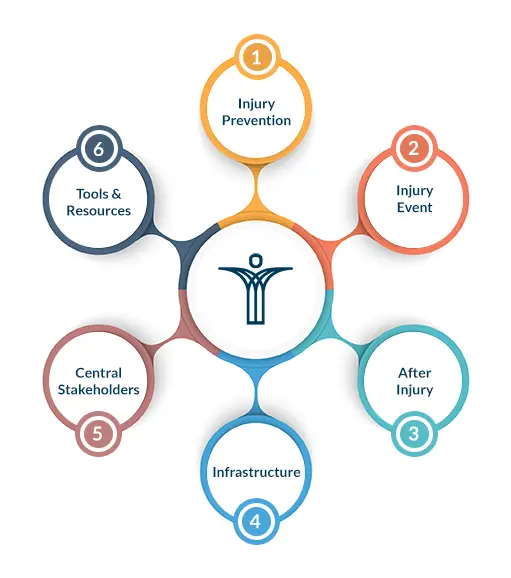
The first area of focus of the “Toolkit” is education regarding the six pillars. Each pillar represents a unique foundational piece of officer MSK injury reduction and rapid return to duty. Each pillar provides leverage for an agency’s efforts in that even a small amount of effort in any pillar can provide an exponentially positive impact.
The Six Foundational Pillars of the “Toolkit” are:
- Pre-injury event actions
- The injury event
- After injury actions
- Infrastructure, Policy, Protocol, and Procedures
- Central Stakeholders and Subject Matter Experts (SME’s)
- Tools to assist in vetting Subject Matter Experts and Providers

Pillar 1
Injury Prevention
A primary area of MSK injury prevention is proper and job specific strength and conditioning. Numerous studies and articles have noted the lack of or poorly aligned physical training practices can contribute to MSK injuries
Pillar 2:
Injury Event
When an injury occurs or is noticed, it is possibly reported by the officer. Injuries can be sudden and acute (occur immediately like a fall and broken bone), cumulative (repeated small-scale traumas that build to a breaking point or stage of intolerance), or cumulative injuries that result in compensatory movement patterns that can exacerbate and result in other overstressed musculoskeletal tissues, or any combination of the above
Pillar 3:
After Injury
The injured LEO receives a history, physical exam, diagnosis, tests if needed (e.g. imaging, nerve studies), and conservative care is either initiated or a referral is made. The referral may be for pain management (either oral pain medication or injections such as an epidural injection) or to acupuncture for pain management. A surgical consultation referral may be required depending on the nature of the injury. Post-operative care would ensue in these cases.
Pillar 4:
Infrastructure
Agency infrastructure, policy, protocol, and procedures can have a major impact on the mitigation of MSK injuries occurring in the first place as well as the speed with which officers progress through the injury to return-to-duty timeline.
Infrastructure refers to all of the elements in place or available to an agency to mitigate or prevent MSK injuries, secure care for officers, ensure a uniform, orderly and consistent process, and provide the agency and other stakeholders with necessary quality data to recognize and analyze trends, take action, assess results, revise approaches as needed, and disseminate appropriate information to stakeholders
Pillar 5:
Central Stakeholders
There are many stakeholders in an officer’s MSK injury. First and foremost, the officer should be the central focus of any and all approaches to MSK injuries. These stakeholders can consist of: Family, Department surpervisors and peers, third party administrators, as well as legislative and oversight committees. It is important to understand who the stakeholders are as it is meant to assist in efforts at building partnerships and securing precise, timely, and rapid care for officer MSK injuries.
Pillar 6:
Tools & Resources
There are many individuals and organizations that might provide strength and conditioning, specialized expertise, or medical services.Critical to an effective and credible program is the legitimacy of providers. Some organizations have experienced and flashy marketing programs, charismatic presenters, and other promotional efforts. These are not necessarily indicative of expertise, competence, or non-competence. Rather, it is the responsibility of the organization to evaluate and vet providers in the MSK injury continuum.